Appropriation of Name or Likeness

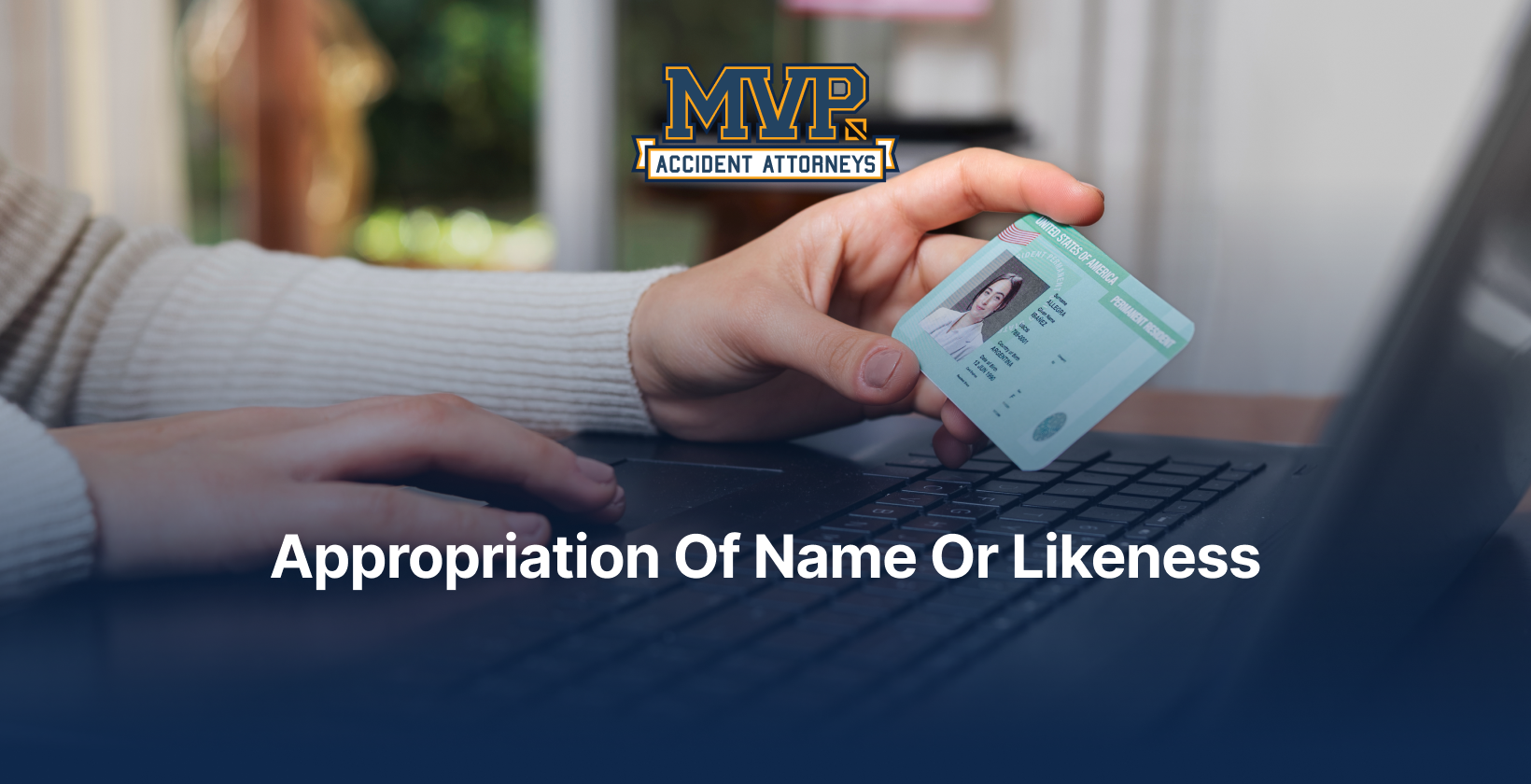
Appropriation of name or likeness is a privacy tort that holds a person liable for using someone’s identity, image, name, voice, or persona without permission to gain a commercial or other advantage. Appropriation of name or likeness protects the ability to decide who profits from your identity, so the injury lands whether the user is a global brand or a neighbor selling shirts. The appropriation meaning in law is narrower than everyday usage, because the claim requires a use that benefits the defendant rather than mere unauthorized copying. California supplies two overlapping routes, and a California invasion of privacy lawyer normally pleads both the common law tort and the statute together.
What is Appropriation in Law?
Appropriation in law is the unauthorized use of another person’s identity for the user’s own benefit, most often advertising, merchandise, or endorsement. Appropriation reaches the commercial exploitation of identity rather than the disclosure of information, so truth and privacy are beside the point. The commercial character of the tort explains why the remedy is measured in the value of the identity taken.
California recognizes the claim twice over. Civil Code section 3344 creates a statutory cause of action against anyone who knowingly uses another person’s name, voice, signature, photograph, or likeness without consent. The prohibited uses are placement on products and use to advertise or sell goods and services. Local TV, LLC v. Superior Court (2016) 3 Cal.App.5th 1 explains that the statute complements the common law claim rather than replacing it, and section 3344(g) makes the statutory remedies cumulative.
The two routes differ in useful ways. Eastwood v. Superior Court (1983) 149 Cal.App.3d 409 held that section 3344 requires a knowing use, while mistake and inadvertence are no defense to the common law claim. KNB Enterprises v. Matthews (2000) 78 Cal.App.4th 362 confirmed that the statute is not limited to celebrity plaintiffs, so an ordinary person whose photograph appears in an advertisement has the same claim.
How do Courts Determine Unauthorized Use of Identity?
Courts determine unauthorized use of identity by asking whether the plaintiff is readily identifiable from what the defendant published and whether the defendant itself put that identity to use. Unauthorized use of identity requires more than a resemblance, since section 3344(b) defines a photograph as one where the person is readily identifiable. Cross v. Facebook, Inc. (2017) 14 Cal.App.5th 190 held that both the statutory and common law versions require the defendant to have actually used the plaintiff’s likeness.
Identity runs wider at common law than the statutory list suggests. Midler v. Ford Motor Co. (1988) 849 F.2d 460 allowed a claim over a deliberate imitation of a singer’s distinctive voice in a commercial, and White v. Samsung Electronics America, Inc. (1992) 971 F.2d 1395 allowed one where an advertisement evoked a television personality through a robot and a familiar set. The lesson for California defendants is that avoiding the name and the photograph does not avoid the claim.
Is Appropriation of Name or Likeness a Type of Invasion of Privacy?
Yes, appropriation of name or likeness is one of the four privacy torts. Appropriation focuses on identity misuse, while intrusion upon seclusion addresses how information was gathered and the two disclosure branches address what was published. Courts group this claim with the other forms of invasion of privacy because all four trace to Dean Prosser’s 1960 classification and to the Restatement Second of Torts. Hill v. National Collegiate Athletic Assn. (1994) 7 Cal.4th 1 confirmed that California common law follows that classification. Appropriation is the one branch that doubles as a property right, which is why lawyers often call it the right of publicity.
What Must be Proven in an Appropriation of Likeness Claim?
An appropriation of likeness claim requires proof of use of the plaintiff’s identity, appropriation of that identity to the defendant’s advantage, lack of consent, and resulting injury. Orthopedic Systems, Inc. v. Schlein (2011) 202 Cal.App.4th 529 sets out that four part common law test and explains what the statute adds on top of it. The four elements below are what a California plaintiff has to establish.
- Use of identity means the defendant used the plaintiff’s name, likeness, voice, or other identifying attribute.
- Advantage to the defendant means the appropriation served the defendant’s benefit, commercially or otherwise.
- Lack of consent means the plaintiff never authorized the use, or the use exceeded the authorization given.
- Resulting injury means the plaintiff suffered economic loss, emotional harm, or both.
A section 3344 claim demands two additional showings. Orthopedic Systems requires proof of a knowing use by the defendant and a direct connection between that use and a commercial purpose. The statutory count is therefore harder to prove and better to win.
The statute also carves out categories. Section 3344(d) exempts uses connected to news, public affairs, sports broadcasts or accounts, and political campaigns, and Gionfriddo v. Major League Baseball (2001) 94 Cal.App.4th 400 places the burden of proving those exemptions inapplicable on the plaintiff.
Does the Use Have to be Commercial to Qualify as Appropriation?
Commercial use is required for the statute but not for the common law claim, which reaches an appropriation to the defendant’s advantage commercially or otherwise. Commercial use under section 3344 means advertising, selling, soliciting purchases, or placing the identity on merchandise. Cross v. Facebook, Inc. (2017) 14 Cal.App.5th 190 rejected the argument that the statutory commercial use requirement can be satisfied without some form of advertising or endorsement aimed at the advertiser’s commercial advantage.
The common law route therefore matters most where the benefit is not a sale. A defendant who uses another person’s name to gain credibility, attract members, or avoid paying a licensing fee may face the common law count even where section 3344 does not fit.
Do you need to Prove Harm in Appropriation Tort Claims?
Harm is an element of the common law claim, though section 3344 guarantees a floor of $750 even when actual damages are never proven. Appropriation claims in California tort law treat resulting injury as the fourth element, so a plaintiff still has to plead and show some harm. The statutory floor removes the practical problem of valuing an unknown person’s identity, since the statute supplies a number where the market does not.
One California decision limits how far that floor stretches. Miller v. Collectors Universe, Inc. (2008) 159 Cal.App.4th 988 held that a claim over 14,060 separate misappropriations of the plaintiff’s name was a single cause of action carrying statutory damages of $750, not $750 multiplied by each use. Emotional distress damages and lost licensing value remain available on top of that figure where the evidence supports them.
What are Examples of Appropriation of Name or Likeness?
Examples of appropriation of name or likeness share one mechanic, which is someone else converting your identity into their own advantage. Appropriation examples cluster around advertising, merchandise, and endorsement because that is where identity carries measurable value. The six categories below cover the fact patterns California courts see most often.
- Advertising photographs placing a person’s image in a print, broadcast, or online advertisement without a release.
- Merchandise printing a name, signature, or likeness on shirts, posters, prints, or collectibles.
- Implied endorsements arranging a photograph or name so an audience believes the person recommends the product.
- Voice imitation hiring a sound alike to suggest a recognizable performer sang the commercial.
- Website and social testimonials reusing a customer photograph or review as promotional content.
- Digital replicas generating a synthetic image, video, or voice that a viewer would identify as a specific person.
Merchandise produced the leading California decision. Comedy III Productions, Inc. v. Gary Saderup, Inc. (2001) 25 Cal.4th 387 involved charcoal drawings of The Three Stooges reproduced on lithographs and shirts. The California Supreme Court held the works were not protected, because they added no significant creative element beyond the likenesses themselves.
Is Using Someone’s Photo in Advertising without Permission Illegal?
Yes, using someone’s photograph in advertising without permission is unlawful in California under Civil Code section 3344 and the common law tort. Advertising is the core conduct the statute targets, so the analysis usually turns on identifiability and consent rather than on whether the use was commercial. Section 3344(b) requires that the person be readily identifiable in the photograph, meaning a reasonable viewer could determine who it is.
Celebrity status is irrelevant to liability. KNB Enterprises v. Matthews (2000) 78 Cal.App.4th 362 confirmed that the statute reaches ordinary plaintiffs, and a model whose test shots appear in an unlicensed campaign has the same claim as a public figure.
Can Social Media Posts Count as Appropriation of Likeness?
Yes, social media posts can be appropriation when a business account uses someone’s image or name to promote itself. Social media posts by a private individual sharing a photograph for personal reasons rarely qualify, because no commercial advantage attaches. The dividing line is promotional purpose, so a salon reposting a client photograph to advertise services stands differently from a friend posting the same picture.
Tagging and captions can supply the commercial connection the statute needs. A business that pairs a customer photograph with a product link, a discount code, or a service pitch has used that image to advertise, which is the conduct section 3344 describes.
Can a Company Use Employee Images without Consent?
Consent is not required for every use of a person’s image, but a company needs written consent before using employee images in advertising or marketing. Employee images used for internal directories, badges, and operational purposes usually fall outside the appropriation claim because no commercial advantage is being extracted. Employee images that appear in recruiting campaigns, brochures, websites, and social advertising are promotional, so a release is the safe course.
Two limits matter to California employers. An employee’s consent given while employed does not automatically survive separation. A release covering one campaign does not cover a later one, since the consent element fails whenever a use exceeds the authorization given. Section 3344(d) still exempts genuine news and public affairs uses, which is why a company newsletter reporting an award reads differently from a recruiting advertisement.
What is Considered Commercial Use of Someone’s Likeness?
Commercial use of someone’s likeness is any use that advertises, promotes, sells, or solicits purchases, including placement of the likeness on the product itself. Commercial use covers a print advertisement, a broadcast spot, a landing page, a package, and a piece of merchandise. The commercial character of a use is a question of connection rather than medium, because section 3344(e) provides that appearance in a commercial medium does not by itself create liability.
Comedy III drew the distinction sharply. The California Supreme Court noted the difference between putting a celebrity’s name on a special edition of a vehicle and using that name in a commercial to endorse the same vehicle. Both fall within the statute, though they are not the same act.
Expression sits on the other side of the line. Comedy III created a transformative use defense, asking whether the celebrity likeness is one of the raw materials from which an original work is built or whether the depiction is the entire substance of the work. Winter v. DC Comics (2003) 30 Cal.4th 881 applied that test in favor of the defendant, holding that comic book characters drawn from two musicians were sufficiently transformed.
What Happens if a Brand Uses a Celebrity Image without Permission?
A brand that uses a celebrity image without permission faces the celebrity’s actual licensing loss, the brand’s own profits from the use, and an injunction pulling the campaign. Celebrity claims often exceed ordinary appropriation claims because the licensing market supplies a concrete number, and a documented endorsement fee becomes the measure of actual damages. The damages exposure grows where the placement implied an endorsement the celebrity never gave.
Federal law adds a second front. Section 43(a) of the Lanham Act supports a false endorsement claim where an unauthorized use is likely to confuse consumers about sponsorship, so a national campaign can draw parallel state and federal counts.
Is Influencer Content Protected Under Likeness Rights?
Yes, influencer content is protected, because California likeness rights do not depend on fame. Influencers hold the same statutory and common law claims as any other person, and KNB Enterprises v. Matthews (2000) 78 Cal.App.4th 362 makes clear that section 3344 reaches non celebrity plaintiffs. Influencers also create the exposure in the other direction, since a sponsored post featuring another person’s face or voice is advertising within the meaning of the statute. Brands that repost influencer content beyond the licensed scope face the same problem, because a use exceeding the authorization given defeats the consent element.
What Damages can be Awarded for Appropriation of Likeness?
Damages for appropriation of likeness are built around the market value of the identity taken plus whatever the defendant earned from taking it. Courts value identity misuse by asking what a willing licensee would have paid for the same use, then adding the profits attributable to the unauthorized use. The five categories below are available under Civil Code section 3344.
- Actual damages measured by the fair market licensing value of the use, plus emotional distress where proven.
- Statutory damages of $750 as a floor, available without proof of actual loss.
- Attributable profits representing the defendant’s gain from the unauthorized use.
- Punitive damages where the conduct was willful, oppressive, or malicious.
- Attorney’s fees and costs awarded to the prevailing party under section 3344(a).
The fee provision changes settlement behavior more than the damage figures do. A prevailing party recovers fees either way, so a defendant facing a modest actual damages claim still faces real exposure, and a plaintiff with a weak claim faces the same risk in reverse.
California created a separate figure for synthetic media. AB 1836 amended Civil Code section 3344.1 to cover digital replicas of a deceased personality’s voice or likeness in an expressive audiovisual work or sound recording. Liability there is the greater of $10,000 or actual damages.
Can Companies be Sued for Using Someone’s Image without Permission?
Yes, companies can be sued directly and can also answer for what their marketing staff and agencies do. Companies are the usual defendants in appropriation cases because they hold the advertising budget and the profits the statute reaches. The corporate exposure follows ordinary agency rules, so a business answers for an employee who pulled an image from the internet and for an agency acting on its instructions.
Knowledge is the one hurdle unique to the statute. Section 3344 requires a knowing use, so a company that can show a genuine mistake may defeat the statutory count while still facing the common law count, where mistake and inadvertence are no defense under Eastwood.
Can Courts Stop Unauthorized Use of Someone’s Likeness?
Yes, California courts can order a defendant to stop using a likeness and to pull the material already published. Injunctive relief is the remedy plaintiffs want most in appropriation cases, because a campaign left running keeps compounding the harm. The relief can reach printed material, websites, packaging, and advertising placements a defendant still controls.
Speed matters more here than in most privacy claims. A plaintiff can seek a temporary restraining order and a preliminary injunction early, and Christoff v. Nestlé USA, Inc. (2009) 47 Cal.4th 468 applied the single publication rule in Civil Code section 3425.3 to unauthorized commercial use of likeness, which affects how a long running campaign is counted.
How can I Protect My Image or Name from Misuse?
Protecting your image or name comes down to putting the terms in writing before anyone uses it and watching for uses you never approved. Protection is cheaper before the misuse than after, because a signed release resolves the consent question that decides most cases. The six steps below reduce exposure under California law.
- Use written releases for every commercial use, and name the media, the territory, and the term.
- Limit the license to specific campaigns rather than granting rights in all media in perpetuity.
- Address digital replicas expressly in any contract, since a general likeness clause may not cover synthetic recreation.
- Register your name as a trademark where you use it to sell goods or services.
- Monitor for misuse with reverse image searches and name alerts on a set schedule.
- Document what you find by capturing the advertisement, the date, the platform, and the reach.
California added protection for performers negotiating these terms. AB 2602 created Labor Code section 927, which makes a contract provision permitting a digital replica unenforceable as to new performances fixed on or after January 1, 2025. The provision fails where it lacks a reasonably specific description of the intended uses and the individual had neither legal counsel nor union representation.
When should I Contact a Lawyer for Identity Misuse?
A person should contact a lawyer for identity misuse as soon as the unauthorized use is discovered, because the deadline is short and the evidence moves fast. Identity misuse claims in California carry a two year limitations period under Code of Civil Procedure section 335.1, and campaigns come down before anyone thinks to preserve them. The early window is also when an injunction does the most good, since a live campaign can still be pulled.
Two other reasons favor moving early. A demand letter sent while the campaign is running often produces a license fee rather than litigation. The single publication rule from Christoff further means the counting of a long campaign may turn on when the first publication occurred.
Can a Personal Injury Attorney Handle Appropriation of Name or Likeness Cases?
Yes, some personal injury attorneys handle appropriation of name or likeness cases, though the claim sits closer to intellectual property than to bodily injury. The overlap is real, since the emotional distress component and the two year limitations period match ordinary personal injury practice. A personal injury attorney with real right of publicity experience can also value the licensing loss, weigh the transformative use and news exemption defenses, and decide whether a Lanham Act count belongs alongside the state claims. Those questions decide the value of the case and sit outside the ordinary collision and premises caseload, so asking a firm how many likeness matters it has litigated is worthwhile. A free case review is the usual starting point for a California appropriation claim.
Share this article:
Related Articles

Standard of Care
Libel: Definition and Meaning in Law